Category: Uncategorized
8x10s

On finishing the 5×7 test prints from my first folder of 35mm black and white negative film, I have started making larger 8×10 prints of the most striking tests. I have been making these on 8×10 inch sized paper.
The images are mainly from my locality, with which I hope to make a more ambitious photo zine than before, maybe A6 or A5 sized, but I won’t make any decisions until I’ve properly gathered all the images I want around a particular theme or sequence.
There are differences in method: after testing, I’m pretty certain of which filter grade I want to print with, which cuts time; but with a larger print I can do more dodging and burning to get what I want.
Now that I’ve learned to be less profligate when making test prints, I am making more large prints than before, especially in my second folder. Beyond the next photo zine, I’m not entirely sure of where these prints will end up, but it has been fun making them and watching the results develop.
A return
I’ve imported my site from WordPress.org to this one.
There’ll be a number of adjustments over the next few weeks, with menus, design and links, but I’m very happy that my blog’s back here.
I’m also very happy to be getting reacquainted with you soon.
An optimistic year
Thanks to finding a cache of files, I’ve been editing some digital photos from years gone by. I am currently working through images from 2012.
This year holds a number of memories for me, but chief among them was my involvement on the periphery of the London Olympics. Working in road traffic control at Transport for London, I was part of a large team that kept traffic moving during the events. We’d prepared for it over the previous years across departments and with the police, the military and countless stakeholders. The delivery was an intense, enjoyable and comradely experience.
One day in the lull between the Olympics and Paralympics, a number of us were sent on a site visit across the various Olympic sites. We travelled to the Excel Centre, Queen Elizabeth Park and North Greenwich, returning to work on the Thames ferry, from where this photo was taken.

It’s strange looking back on this time, the Olympics events and especially its opening ceremony from today. The opening ceremony’s celebration of West Indian immigrants on the MV Empire Windrush, as well as the UK’s National Health Service stayed in the memory (along with a Conservative MP’s dismissal of it all as “multicultural crap“.) 2012 felt genuinely optimistic.
In the years that followed, we’ve had Nelson Mandela’s death, the Ebola epidemic, the rise of Daesh, earthquakes in Nepal and Italy, the Camp Speicher massacre in Iraq, the Paris attacks, the Grenfell Tower fire, the Syrian Civil War, the Windrush deportations, the Hong Kong protests and this current pandemic: events that have shaken whatever optimism I may have felt to the core. Looking back on that opening ceremony, I wonder how valued the NHS really was, or if my optimism back then was in a bubble, or just a foolish response to a manufactured event.
These and other intervening events have revealed how we have valued some people over others and how we’ve valued economic systems over people. For instance, the current rise in estimation of key workers has been significant: what happens after this pandemic will be telling. Will we give our venerated teachers, bin men, street cleaners, carers, deliverers, postal workers and retail staff decent pay, conditions and contracts, or return to the denigration of their work and workforce? I hope for the former option: such a change is something to be optimistic about.

Top ten and half the sky
A friend tagged me on a social media site to list ten significant albums over ten days: “albums that really made an impact and that you still play today, even if only now and then,” ran the definition. I don’t think that what I chose were my absolute favourite albums (I think in a couple of cases I chose whichever album that was on my mind that day), but they each meant something to me and I aimed to get that across in my comments.
The albums I chose were: Miles Davis – Kind of Blue; Muse – Absolution; Steve Reich – The Desert Music; Mike Oldfield – QE2; My Bloody Valentine – Loveless; Marvin Gaye – What’s Going On; Howard Skempton – Lento (not an album, really, but it has affected me greatly); John Barry – Goldfinger; Gary Numan – The Pleasure Principle; and Led Zeppelin III.
Having nailed my colours to the mast, I thought about this list for some days, wondering why there were only two artists of colour and no women musicians at all. There was a fair amount of rock music, so why didn’t I consider Living Colour’s powerful Time’s Up? I included one album I’ve never actually owned, so why didn’t I choose Carole King’s Tapestry, for which I have an equal affection (and lack of ownership)? Wasn’t I fascinated by Beyonce’s last two solo releases? Wasn’t I a huge Kate Bush fan?
While I could bat away such doubts by insisting that this was a spur of the moment list at best, I was troubled. While this short list excluded a lot of my favourite artists, it made me think a lot about the music I was listening to regularly, and which artists I was ignoring. This wasn’t restricted to music: the ratio of female-to-male writers on my bookshelves is shocking. I’ve only recently started reading science fiction by black female writers and I am stunned by what I have missed out on so far.
Maybe this is the big issue: by following a fairly mainstream cultural line, I am missing out on vast swathes of creativity. Some artists, mainly artists of colour and women, have to fire on all cylinders – be they musical, visual and verbal – before they can be considered alongside a male artist who can concentrate on just putting out good music. It’s unfair and I’ve been contributing to it.
I’ve been making an effort to hear new voices in culture, but it seems like I must redouble my efforts when considering the movies, music and art I’m consuming. This isn’t about quotas, but more about looking a little further and wider than I normally do.
Look closer
The Lawrence Alkin Gallery has exhibited terrific work; I remember one highly enjoyable group exhibition they put together at Shoreditch House last year. One of the artists represented was Glasgow-born Nick Smith; recently he had a new exhibition open at the gallery itself on New Compton Street.
Called Paramour, Smith’s work is inspired by erotic literature and uses his pantone-like “colour-chip” methodology: dozens of colour blocks forming an alluring image; for Paramour, it’s mostly female nudes.
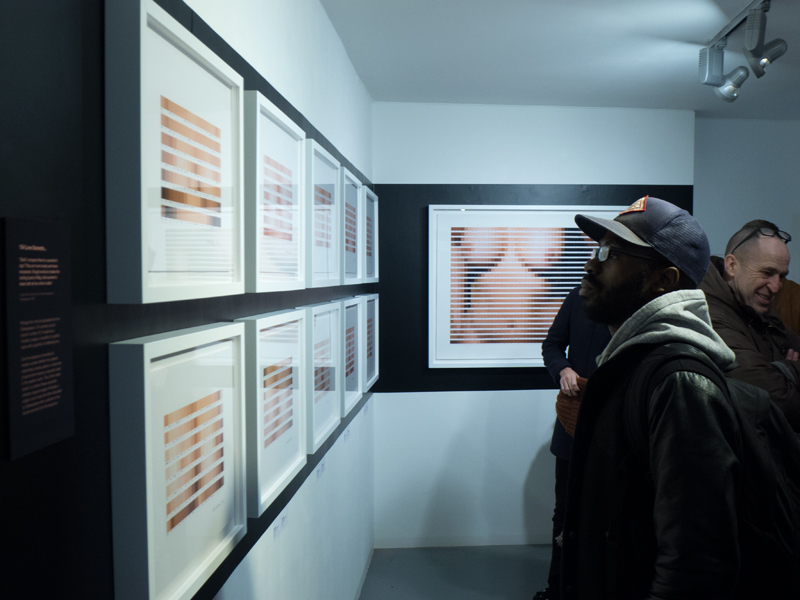
 The artist greets a friend
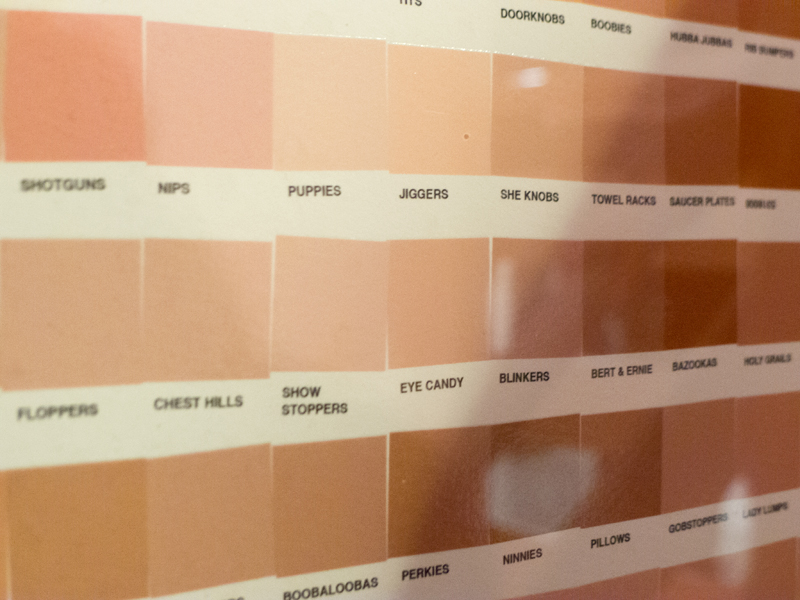 Details

But look closer: the words beneath the colours aren’t tone names, but narratives (Fanny Hill’s memoirs, Shakespeare’s sonnets) or slang (for sexual positions or breasts); one can’t be too certain until one studies an image very closely. The effect is sexy and funny and at times romantic.
Smith’s work is widely varied, but Paramour follows a certain theme. At one point, I chatted with other attendees about what words he should use next: Georges Bataille’s Story of the Eye? Who knows where he’ll go next?
Paramour will be in exhibition until April 16 2016.
London Film Festival, 2013
I love the British Film Institute: its cinemas, library, mediatheque, bars, restaurant, cafe, bookshop and galleries are a delight to use; I could happily spend a whole day there experiencing every aspect of it.
However, that devotion doesn’t really extend to the BFI London Film Festival: I find that I don’t go that often when it comes around. I’m not sure why: maybe because there’s so much choice, leaving me unable to make a decision; maybe because much that’s on exhibition gets to have a regular release shortly after the festival, keeping me from rushing to see anything in particular; or maybe because I’m just too damn lazy – friends of mine get to see a plethora of fabulous films without breaking a sweat, while I’m at home, ticking various titles and scheduling when I can go through my diary to make arrangements to see them.
Still, friends do go: I have had wonderful experiences at the festival through chance and invitation. Some years ago, I won tickets to attend a conference on directors and critics, led by Mark Kermode. More recently, a former housemate invited me to join him and his then girlfriend to see a gorgeous new print of The Big Heat. This time around, friends invited me to attend two fascinating director’s talks with them.
The first was with Alfonso Cuaron, here to talk about his new film Gravity. Appearing with the director was the film’s visual effects director, Tim Webber. The event started with four scenes from the film being screened… As the audience collectively picked their jaws up from the floor, a good humoured and erudite discussion followed about the film’s production, actors and visual effects. (I saw the film last weekend and I have to see it again: great stuff!) The film makers’ drive and passion were well evident: four years spent making the film as good as they wanted it needed such drive. I’m sure film makers in the audience returned to their own projects with renewed vigour.


The other event I attended was with Hirokazu Koreeda. Some years ago, I watched his film After Life; a film that I’d recommend to pretty much anyone. A later film, Still Walking, unfolded like a great novel. Earlier this year, he released I Wish. A friend said the film was so life affirming that it should be prescribed on the NHS and I’m inclined to agree with him; funny, profound and moving, I Wish made my heart sing. Koreeda was here to talk about his latest film, Like Father Like Son, a story about two families’ sons who had been swapped at birth. Appearing with a translator, the Japanese director talked of his techniques, influences and projects. I listened with a smile on my face: the humanity in his films shone out of him and the event made me want to both do more of my own work and see more of his.


Two events, both informative, entertaining and inspiring, seen by chance. If that isn’t an encouragement to see more next year, then I don’t know what is. My friends are talking of meeting next year with their festival catalogues in order to coordinate what they see. I think that I’ll join them.
Something new
I’m making a short film about cycling. Here I am on Waterloo Bridge, videoing myriad cyclists during Ride London a few weekends ago.

There’s a couple more days of shooting, then logging, editing, post-production… Then I will shoot something else.
Hanging around
Some time ago, I missed going to see a certain artwork, so I posted about some other sculpture I passed by instead. Since then, I took the time out to visit the public art that I wanted to post about in the first place: the Dalston House, a commission by the Barbican by Argentine architect Leandro Erlich.
I’d seen this on the news and I couldn’t quite believe how it worked: in an empty lot on a Hackney street, the facade of a 19th century terraced house was laid out on the ground. Above this a mirror at a 45-degree incline reflected this facade. The result? By sitting or lying on various spots on the ground, one could appear to be dangling from windows or scaling the walls. Fantastic, really.
It was very popular, with an usher informing new arrivals to the queue of a 75 minute wait to use the work. On arrival, one had five minutes to use the work, take photos and generally have a lot of fun. The real fun for me was in watching others use the site: it was as much to be looked at as used; once I was able to play on the site, it was a touch difficult to get the most out of it on my own. Families and couples, with some posing and others photographing, had a great time.
 “75 minutes waiting time? Really?”
 “75 minutes photographing this? Oh, okay then…”
 Posing on the artwork…
 …to be reflected in the mirror…
 …and make fun photos!
 A welcome addition of a welcome mat.
 My turn! I took a lot of photos of my play on the artwork; this was one of the few that turned out okay.

However, a nice chap called Paul took my photo at my request.
 Such strength!
Mr. Erlich is known for his immersive works, which I am going to look into reading about, if not seeing, in future. In the meantime, my photographs and others images and videos will remind me of this extraordinary work.
Some music
I love music. Music is an integral part of my life: my radio is on through the night; I listen to music on the Internet and every new music show I can find; and I’m more than happy to glean new music from friends’ interests.
It was this last aspect; and a shared liking for the dj Gilles Peterson; that saw a friend and I at the Village Underground in Shoreditch. Coming from a late shift, I missed Mr. Peterson’s set unfortunately, but I did see the main act: Owiny Sigoma Band.
Beyond an interview caught on Gilles Peterson’s BBC Radio 6Music show, I knew very little about this group: a group of four British musicians visited Nairobi to collaborate with Kenyan musicians. The collaborations went well: we were watching the result; six musicians delivering a rhythmic, melodic and positive attack that held the audience in a sweaty trance.
Stood at the front, I was glad to be able to take a few photos.
 The band comprise Jesse Hackett (keys), Louis Hackett (bass), Sam Lewis (guitar) and Tom Skinner (drums) from the UK and Joseph Nyamungu and Charles Owoko from Kenya.


 Their Nairobi sessions resulted in a four tracks: on hearing them, Gilles Peterson signed them to his Brownswood label. The following recording sessions on their return to Nairobi went onto the band’s self titled debut album.
 Their percussionist (somewhat blurred in the background) joined them for their last track: I’ll be acquiring more of Owiny Sigoma Band’s music shortly.
White Horse, mark 1
Cycling home from a night shift, I chanced by a sculpture just off The Mall by the British Council offices: Mark Wallinger‘s White Horse.

A life sized sculpture of a horse on a wide dais, Mark Wallinger’s sculpture is a small scale version of a somewhat larger project, the Ebbsfleet Landmark Project, of a white horse some 50 metres high, 33 times life size, to be built in the Ebbsfleet Valley in Kent.


While the Landmark Project is in limbo because of the current financial crisis, this beautiful work is enough for me. I became a fan of Wallinger after seeing his 1999 work Ecce Homo on the fourth plinth in Trafalgar Square. Being raised a catholic, I was amazed at the depiction of Christ as a humble, ordinary man; not oversized, but still powerful. His placing on the plinth, standing towards one edge, was also striking.

The same thing happens here, with the White Horse placed just so, off centre and to the rear of the dais, calm and in control.
While I’ve continued to enjoy Wallinger’s work, I was somewhat shocked to find out that this sculpture has been in place since March. Are there any other lesser known, but still fantastic works of public art in London that I should get to see soon?
 Burning Details
You must be logged in to post a comment.